When Doing Nothing Is the Most Responsible Choice
Before We Begin…If you’ve been reading these letters over the past few years, I’d love to hear from you. Has something shifted for you? Writing these takes time, thought, and emotional labor. It’s work I care deeply about — and it’s something I show up for consistently. If these letters have impacted your life in any way, the greatest support you can offer is simple: • Share this with a friend who would benefit. This is a community built on growth — and growth is always reciprocal. Now, let’s begin. — Esther
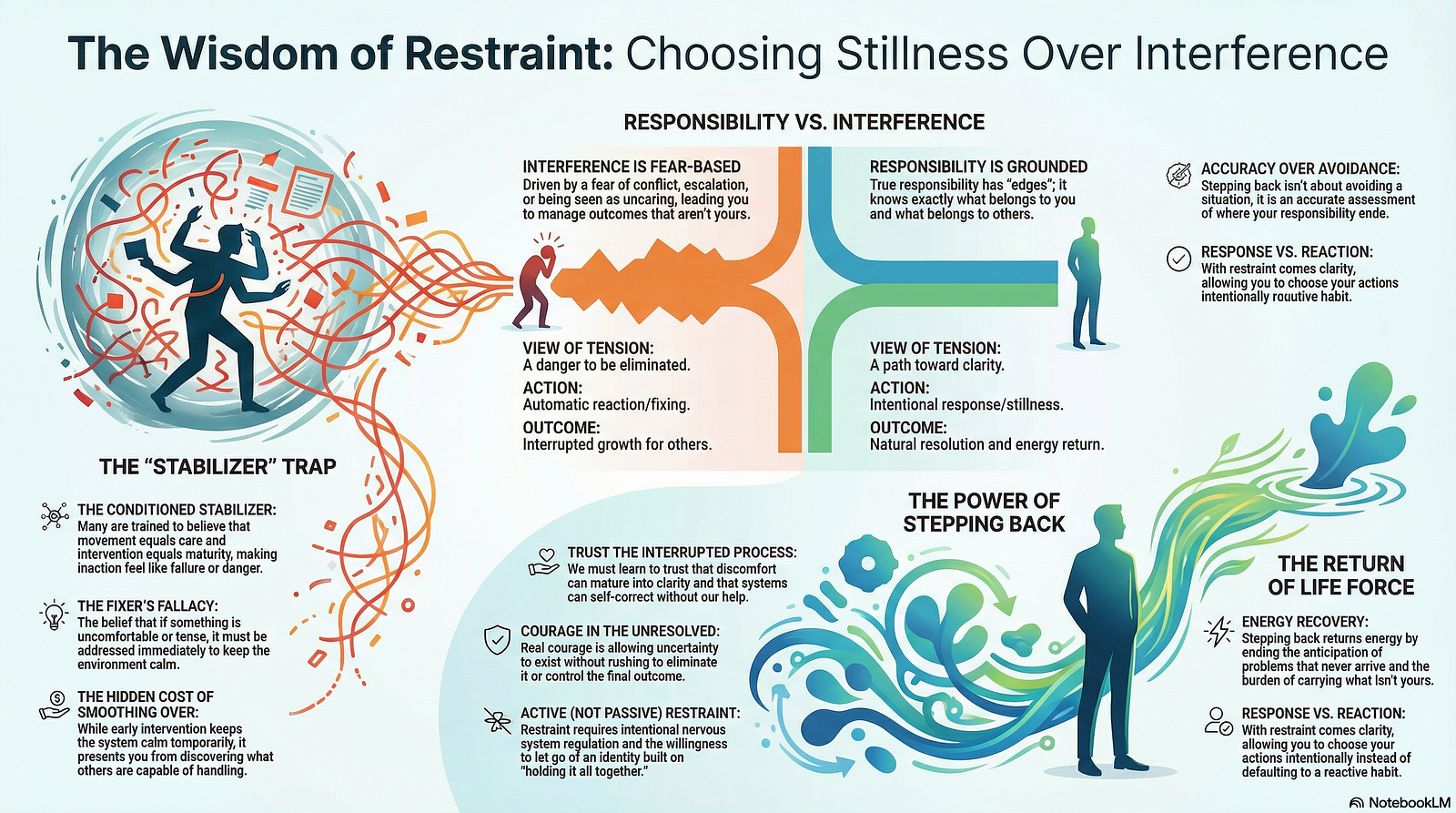
There’s a moment in growth that feels deeply uncomfortable, especially for people who were trained to stabilize their environment. It’s the moment when you realize that doing less — or doing nothing — might actually be the most responsible option available. For those of us conditioned to resolve tension, fix problems early, or absorb responsibility just to keep things calm, inaction can feel like neglect. Like danger. Like failure. We were taught, implicitly or explicitly, that movement equals care, that intervention equals maturity, that if something is uncomfortable, it must be addressed immediately. But not all situations need fixing. Sometimes stepping back isn’t avoidance. The Difference Between Responsibility and InterferenceThere’s a quiet distinction most of us were never taught to make: the difference between being responsible and interfering. Responsibility is grounded. It has edges. It knows what belongs to you and what doesn’t. Interference, on the other hand, often comes from fear — fear of escalation, fear of conflict, fear of being seen as uncaring, fear of what might happen if you don’t step in. When you’re trained to be the stabilizer, interference can feel like care. You step in early. You smooth things over. You take responsibility for outcomes that were never yours to manage. And for a while, this works. The system stays calm. The tension dissolves. Everyone moves on. But something subtle happens over time. You don’t get to find out what others are capable of handling. The cost isn’t immediate — it’s cumulative. Trusting the Process You Keep InterruptingOne of the hardest shifts in adulthood is learning to trust processes you were trained to interrupt. To trust that:
When you step back, you might feel anxious at first. Your body may register danger, even when none is present. That’s not intuition — that’s conditioning. You were taught that waiting is risky. But sometimes, stillness is the most honest response. The Courage to Let Things Be UnresolvedThis is where real courage lives — not in confrontation, not in fixing, but in allowing uncertainty to exist without rushing to eliminate it. Letting something remain unresolved doesn’t mean you don’t care. It means you care enough not to control the outcome. It means you trust yourself to stay present without managing everything. This kind of restraint isn’t passive. It requires nervous system regulation. When Doing Less Restores Life ForceMany people don’t realize how much energy is spent anticipating problems that never actually arrive. Stepping back returns energy because:
Life force returns when effort becomes intentional instead of automatic. And with that return comes something unexpected: clarity. You begin to see more accurately. An InvitationThis letter isn’t asking you to disengage from your life. Where are you intervening out of habit rather than necessity? This is Letter #4 in the series No One’s Coming to Save You — a practice in trust, discernment, and learning when doing nothing is not avoidance, but wisdom. Let this one settle. With care, |
Esther Levy
Mind & Body Programming | The Art of Preparation | Author of "Interior Design of the Body" | Self-Growth | Motherhood | Holistic Health.